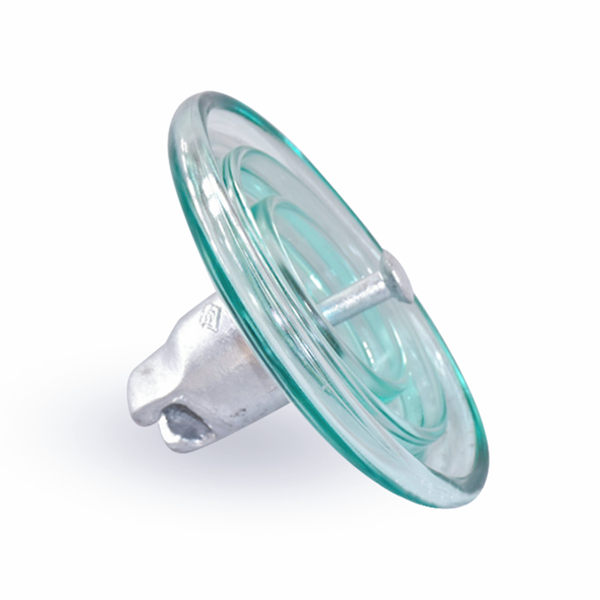
Fog Type Glass Insulator
The fog type profile is characterised by long andwidely-spaced under-ribs, which prevent arc bridgingbetween adjacent ribs. It is particularly effective incoastal areas (salt-fog environment) as well as inlocally polluted areas where a higher specific leakage distance* is required.
Types of glass insulators
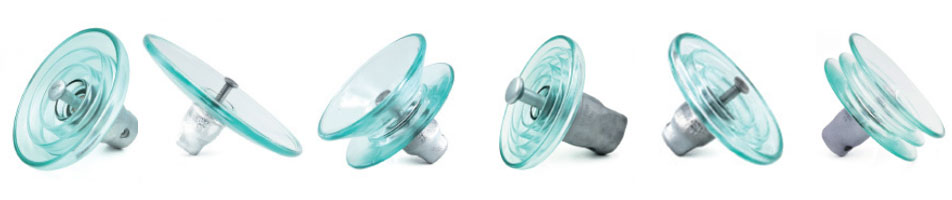
Disk suspension glass insulators are divided into Standard Type, Anti-pollution Type, DC type, Aerodynamic Type, Out-ribs Type and Ground Wire Type.
The Cap and Pin suspension type glass insulators produced by our company include: 40~550kN standard profile, 70~300kN fog type profile, 70~240kN open profile, 70~100kN ground profile and 70~240kN double shed profile, which can be widely applied in high-voltage, extra-high-voltage and ultra-high-voltage transmission line with voltage grade between 10KV and 1000KV.
Characteristics of glass insulators
Small size, light weight, zero-value self-breaking, and easy detection; high mechanical strength; good arc resistance; good self-cleaning performance and not easy to age. In addition, the spraying material has the advantages of strong hydrophobicity, long-term resistance to pollution, low leakage current on the surface, and maintenance-free during operation; it is widely used in various circuits at home and abroad.
Glass part profiles of toughened glass insulators
Standard profile
Design of insulating part has small ribs. insulators of standard profile perform well in areas of mild contaminations. Creepage distance is over the mandatory requirements of international standards.
Fog type profile
Design of insulating part has strongly extended ribs which protect from flowing contaminations and dry depositions. The distance between ribs prevents frompartial discharge between adjacent ribs under severe contamination. Such insulatorsperform well in areas with industrial pollution, heavy rainfall and coastal areas.
Open profile
Design of insulating part with open profile is marked by absence of under-ribsand extended diameter of disk. Open profile reduces pollutant accumulation on the surface. This design is effective in desert areas with wind and sandstormsand also can solve ice-bridging problems.
External shed profile
Design of insulating part has two external ribs. As a result of ribs arranged on the side face, the surface of insulator is self-cleaned by strong wind. insulators perform well in areas with industrial pollution and salty soil.
| Item |
Spacing(mm) |
Diameter(mm) |
Creepage Distance(mm) |
| U40B |
110 |
175 |
190 |
| 100 |
175 |
190 |
| U70BS |
127 |
255 |
320 |
| U70BL |
146 |
255 |
320 |
| U100BL |
144 |
255 |
320 |
| U100BS |
127 |
255 |
320 |
| U120B |
146 |
255 |
320 |
| U120BS |
146 |
280 |
450 |
| U160BL |
170 |
280 |
400 |
| 155 |
280 |
400 |
| U160BS |
146 |
280 |
400 |
| U210B |
170 |
280 |
400 |
| 170 |
280 |
450 |
| 170 |
280 |
400 |
| 170 |
280 |
450 |
| U300B |
195 |
320 |
485 |
| U400B |
205 |
360 |
550 |
| U530B |
240 |
380 |
620 |
| 300 |
400 |
700 |
| U70BLP |
146 |
255 |
400 |
| 146 |
280 |
450 |
| 146 |
320 |
550 |
| 146 |
255 |
400 |
| U100BLP |
146 |
280 |
450 |
| 146 |
320 |
550 |
| 146 |
255 |
400 |
| U120BP |
146 |
280 |
450 |
| 146 |
320 |
550 |
| 155 |
280 |
450 |
| U160BLP |
170 |
280 |
450 |
| 170 |
320 |
550 |
| 155 |
320 |
550 |
| U120BP |
170 |
320 |
550 |
| 170 |
320 |
550 |
| 195 |
320 |
550 |
| U120BP |
195 |
360 |
635 |
| 240 |
360 |
635 |
| 52-3A |
255 |
146 |
320 |
| 52-5A |
255 |
146 |
320 |
| 52-8A |
280 |
146 |
400 |
| 52-11A |
280 |
155 |
400 |
| 52-4A |
255 |
146 |
320 |
| 52-6A |
255 |
146 |
320 |
| 52-10A |
280 |
165 |
380 |
| 52-3FA |
280 |
146 |
450 |
| 52-5FA |
280 |
146 |
450 |
| 52-8FA |
280 |
171 |
450 |
| 52-11FA |
280 |
170 |
450 |
Contact us and get support with more product information.
Product Advantages
Pollution Flashover Mitigation
The fog type profile's extended under-ribs and spaced contours limit surface contamination from forming continuous conductive paths. In high-pollution and salt-fog environments, this feature greatly reduces the chance of flashover, even during heavy rain or mist. Hydrophobic surface coating resists water film development and slows down pollutant adherence. The combination of material and geometry ensures superior insulation stability and minimal leakage over time. These elements make fog type profiles a highly dependable component in environments where high voltage power line insulators must operate without regular manual cleaning or insulation failure.
Mechanical Stability and Visual Fault Detection
Each insulator is built to withstand mechanical stress from both environmental conditions and conductor loads. Available strength ratings from 70 kN to 300 kN provide flexibility across tower designs and span distances. The use of toughened glass not only increases impact resistance but also incorporates a self-diagnostic feature—if damaged, the insulator shatters visibly, enabling ground crews to identify and replace failed units without relying on complex testing. This balance of load capability and field reliability is crucial for sourcing high voltage porcelain insulators and insulators used in large-scale transmission networks requiring safe and visible failure behavior.
Lightweight Build and Maintenance Efficiency
Compared to equivalent porcelain models, these glass insulators weigh significantly less, allowing for easier transport, quicker installation, and lower structural stress on towers. Their smooth surface, paired with strategic rib geometry, promotes natural cleaning by wind and rain, limiting dust and salt accumulation. The result is extended maintenance intervals and consistent insulation performance over time. These benefits are especially valued in remote or hard-to-access locations, where electrical glass insulators need to deliver long operational cycles with minimal service interruptions or performance degradation.
Use Scenarios
Coastal and Marine Environments
Salt-laden air and high humidity present unique challenges for insulator performance. Fog type glass units with long, spaced ribs reduce the likelihood of salt deposits forming conductive layers, while their hydrophobic coating prevents water film formation. This makes them ideal for coastal lines or offshore installations where regular maintenance is difficult. Their consistent arc resistance and environmental resilience make them reliable high voltage power line insulators in regions where pollution and weather conditions intensify surface stress on insulator assemblies.
Industrial Zones with Heavy Emissions
Industrial areas produce particulate matter, acidic gases, and chemical residues that can accumulate on insulator surfaces. The rib design on fog type profiles encourages airflow and rain to clean away pollutants naturally. Hydrophobic spraying adds further defense against contamination and leakage current buildup. These units ensure ongoing performance without requiring frequent water washing or manual intervention. That makes them a preferred alternative to traditional high voltage porcelain insulators, especially where pollution-resistant insulators are necessary for safe and stable operation in active manufacturing or processing belts.
High and Ultra-High Voltage Transmission Networks
Lines operating at high voltages, including ultra-high voltages up to 1000 kV, demand insulators that combine electrical strength with mechanical durability. NJREC fog type glass units, rated up to 300 kN, offer both. Their structure supports heavy conductor load over long spans, and their performance remains stable even in adverse environmental conditions. When deployed on steel lattice towers in major transmission corridors, these insulators meet the key criteria for dielectric security and inspection simplicity. They are an ideal solution for grid engineers needing insulators that maintain structural integrity, visibility, and insulation in multi-climate applications.
About Us
Nanjing Rainbow Electric Co., Ltd. (NJREC), established in 2005, has more than two decades of experience in designing and manufacturing insulation products for transmission lines and transformer systems. The company's production scope includes electrical glass insulators, porcelain insulators, RTV-coated insulators, transformer bushings, and related insulation materials. NJREC operates multiple specialized production plants focused on glass and porcelain processing, composite insulation components, metallic fittings, and electrical insulation material synthesis.
NJREC products serve domestic and international markets across power infrastructure sectors. Export regions include North America, South America, Southeast Asia, Africa, Australia, and Europe. As one of the experienced high voltage insulators manufacturers, NJREC delivers insulators tested to meet international mechanical and electrical standards. Glass units are produced with strength ratings up to 550 kN, a wide selection of rib profiles, and creepage distances suited for demanding environments. Additionally, the inclusion of design features such as zero-value self-breaking, self-cleaning surfaces, and hydrophobic materials supports reliability across operating conditions. As a supplier of high voltage porcelain insulators and high voltage power line insulators, NJREC enables safe and stable performance for long-span, polluted-area, and ultra-high-voltage grid applications.
FAQ
What mechanical strength levels are available for fog type insulators?
NJREC fog type electrical glass insulators are available in strength levels ranging from 70 kN to 300 kN to accommodate various load conditions.
Which voltage grades are fog type glass insulators suitable for?
These fog type insulators are designed for use in systems operating from 10 kV to 1000 kV, covering high to ultra-high voltage networks.
What makes fog type profiles suitable for polluted environments?
Their long and spaced under-ribs reduce arc bridging, and hydrophobic surfaces limit leakage, making them reliable high voltage power line insulators in polluted or coastal areas.
Do fog type glass insulators offer visual fault detection?
Yes. They are made of toughened glass with a zero-value self-breaking feature, which enables easy identification of damage during visual inspection.
Are these insulators lighter than porcelain types?
Yes, fog type high voltage porcelain insulators made from glass are lighter in weight, which helps reduce structural loads and ease field installation.