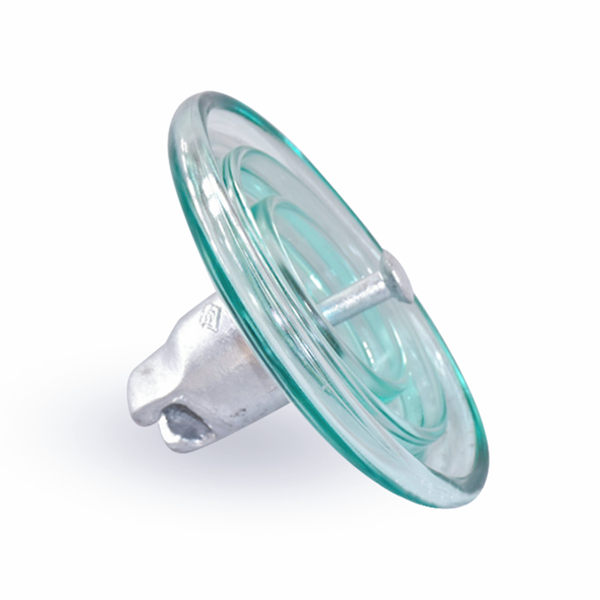
Standard Type Glass Insulator
The Glass Insulator is composed of an iron cap, toughened glass parts and steel pin, which are combined with cement adhesive. Before assembling, the top of the steel pin is provided with a soft gasket, the inner cavity of the iron cap and the pin ends at the contact point with the cement adhesive are covered by tar. The gasket and tar are used to buff in case of damage when insulator facing thermal expansion and contraction. Toughened glass parts are used to insulate.
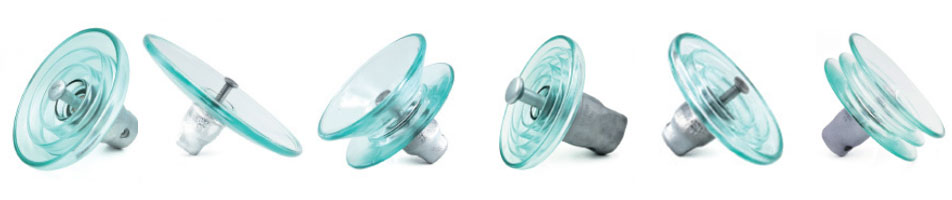
Types of glass insulators
Disk suspension glass insulators are divided into Standard Type, Anti-pollution Type, DC type, Aerodynamic Type, Out-ribs Type and Ground Wire Type.
The Cap and Pin suspension type glass insulators produced by our company include: 40~550kN standard profile, 70~300kN fog type profile, 70~240kN open profile, 70~100kN ground profile and 70~240kN double shed profile, which can be widely applied in high-voltage, extra-high-voltage and ultra-high-voltage transmission line with voltage grade between 10KV and 1000KV.
Characteristics of glass insulators
Small size, light weight, zero-value self-breaking, and easy detection; high mechanical strength; good arc resistance; good self-cleaning performance and not easy to age. In addition, the spraying material has the advantages of strong hydrophobicity, long-term resistance to pollution, low leakage current on the surface, and maintenance-free during operation; it is widely used in various circuits at home and abroad.
Glass part profiles of toughened glass insulators
Standard profile
Design of insulating part has small ribs. insulators of standard profile perform well in areas of mild contaminations. Creepage distance is over the mandatory requirements of international standards.
Fog type profile
Design of insulating part has strongly extended ribs which protect from flowing contaminations and dry depositions. The distance between ribs prevents frompartial discharge between adjacent ribs under severe contamination. Such insulatorsperform well in areas with industrial pollution, heavy rainfall and coastal areas.
Open profile
Design of insulating part with open profile is marked by absence of under-ribsand extended diameter of disk. Open profile reduces pollutant accumulation on the surface. This design is effective in desert areas with wind and sandstormsand also can solve ice-bridging problems.
External shed profile
Design of insulating part has two external ribs. As a result of ribs arranged on the side face, the surface of insulator is self-cleaned by strong wind. insulators perform well in areas with industrial pollution and salty soil.
| Item |
Spacing(mm) |
Diameter(mm) |
Creepage Distance(mm) |
| U40B |
110 |
175 |
190 |
| 100 |
175 |
190 |
| U70BS |
127 |
255 |
320 |
| U70BL |
146 |
255 |
320 |
| U100BL |
144 |
255 |
320 |
| U100BS |
127 |
255 |
320 |
| U120B |
146 |
255 |
320 |
| U120BS |
146 |
280 |
450 |
| U160BL |
170 |
280 |
400 |
| 155 |
280 |
400 |
| U160BS |
146 |
280 |
400 |
| U210B |
170 |
280 |
400 |
| 170 |
280 |
450 |
| 170 |
280 |
400 |
| 170 |
280 |
450 |
| U300B |
195 |
320 |
485 |
| U400B |
205 |
360 |
550 |
| U530B |
240 |
380 |
620 |
| 300 |
400 |
700 |
| U70BLP |
146 |
255 |
400 |
| 146 |
280 |
450 |
| 146 |
320 |
550 |
| 146 |
255 |
400 |
| U100BLP |
146 |
280 |
450 |
| 146 |
320 |
550 |
| 146 |
255 |
400 |
| U120BP |
146 |
280 |
450 |
| 146 |
320 |
550 |
| 155 |
280 |
450 |
| U160BLP |
170 |
280 |
450 |
| 170 |
320 |
550 |
| 155 |
320 |
550 |
| U120BP |
170 |
320 |
550 |
| 170 |
320 |
550 |
| 195 |
320 |
550 |
| U120BP |
195 |
360 |
635 |
| 240 |
360 |
635 |
| 52-3A |
255 |
146 |
320 |
| 52-5A |
255 |
146 |
320 |
| 52-8A |
280 |
146 |
400 |
| 52-11A |
280 |
155 |
400 |
| 52-4A |
255 |
146 |
320 |
| 52-6A |
255 |
146 |
320 |
| 52-10A |
280 |
165 |
380 |
| 52-3FA |
280 |
146 |
450 |
| 52-5FA |
280 |
146 |
450 |
| 52-8FA |
280 |
171 |
450 |
| 52-11FA |
280 |
170 |
450 |
Contact us and get support with more product information.
Our products have passed tests of State Grid Company Wuhan High Voltage Institute and arc test of China Electric Power Research Institute, each performance index and technical parameter of which has reached and surpassed the national standard of the products. Our factory strictly apply a series of tests on raw materials, semi-finished products, metal settings and finished products in accordance with national and internation standards. The tests include: raw materials composition analysis, glass batch ingredient analysis, glass chemical analysis, lighting full-wave impulse test, steep-front impulse test, line frequency withstand voltage test, flash-over test, power frequency puncture test, magnetic particle test, impact test, thermal shock test and etc.
Product Advantages
Broad Mechanical Capability and Durable Materials
Strength ratings from 40 kN to 550 kN enable application across a wide range of transmission line types, from standard spans to heavy-load structures. The toughened glass disc offers strong resistance to impact and deformation, ensuring stability even under fluctuating mechanical stress. Steel pins and iron caps, bonded by cement and sealed with tar at contact points, enhance mechanical connection and accommodate thermal expansion. This construction reduces the likelihood of fatigue damage over time. Additionally, gaskets help absorb movement between metal and glass interfaces. Customers relying on glass insulators in demanding climates or long-distance installations benefit from reduced breakage rates, long-term material resilience, and consistent insulation performance under both electrical and mechanical stress conditions.
Visual Fault Detection and Maintenance Ease
The insulator features zero-value self-breaking, meaning internal damage results in visible breakage, which simplifies inspection without the need for specialized detection equipment. This makes line maintenance more efficient and reduces downtime caused by hidden failures. Furthermore, the relatively small size and light weight allow easier handling during installation and replacement, improving workflow and reducing manual labor burden. The smooth surface structure promotes natural self-cleaning, helping to remove dust, moisture, or industrial pollutants during wind or rain. These advantages are especially valuable for users depending on glass electrical insulators in remote or difficult-to-access areas where inspection intervals are long and consistent performance is essential for grid reliability.
Profile Diversity for Pollution Resistance
NJREC's toughened glass insulators include a wide array of profile types—such as Fog, Anti-pollution, Out-ribs, and External Shed—that are designed to address different environmental challenges. These profiles vary in rib geometry, creepage distances, and overall diameter to suit polluted, coastal, or high-moisture areas. For example, the Fog type features extended rib structures that lengthen the creepage path, reducing the chance of flashover in high-humidity or salt-laden conditions. Many insulator types provide creepage distances well above standard requirements, further improving resistance to surface leakage. This range of profiles is essential for users selecting green glass insulator units for installations where long-term insulation integrity must be maintained despite the presence of airborne contaminants or harsh weather.
Use Scenarios
Transmission Lines Across Voltage Ranges
These glass insulators are engineered for reliable operation across a wide voltage spectrum from 10 kV up to 1000 kV. Whether used in medium-voltage rural networks or ultra-high-voltage long-distance corridors, NJREC’s insulators accommodate variations in line span, conductor weight, and structural stress. Available profiles—including Standard, Fog, Open and Double Shed—allow designers to match product type with system load and insulation distance needs. Mechanical strength options up to 550 kN offer flexibility in configuring string lengths or suspension arrangements. For customers needing glass insulators tailored to specific technical standards or geographic requirements, the adaptability across voltage classes makes these insulators a strong option for both grid expansions and infrastructure upgrades.
Coastal, Industrial or Polluted Environments
Installations near coastlines or industrial centers often face persistent exposure to salt spray, dust, chemical residues, or high humidity. NJREC’s fog-type and anti-pollution profiles provide improved environmental resilience by incorporating extended ribs and increased creepage distances. This structural adaptation ensures better self-cleaning during rainfall and decreases surface conductivity caused by contaminants. Even in regions with acidic emissions or dust storms, these insulators help preserve performance and reduce flashover risks. The stable performance of glass electric insulators in such environments contributes to fewer service interruptions, less frequent cleaning cycles, and greater confidence in transmission system resilience. For systems operating in chemically active or moisture-laden settings, specialized profiles provide a meaningful layer of protection.
Remote or Harsh Climate Installations
Transmission lines installed in remote mountains, deserts, or areas with extreme temperature variation require robust components that combine low maintenance needs with high reliability. These toughened glass insulators offer strong arc resistance and visual break detection, both of which are essential when frequent inspection is impractical. Their resistance to thermal cycling, ice buildup, and UV degradation means they maintain function in extreme cold or intense sunlight without surface cracking or loss of dielectric strength. The combination of durable structure and minimal upkeep makes them a dependable choice for grid sections that must operate autonomously for long periods. Users depending on glass insulators in remote terrains benefit from consistent mechanical strength and reduced replacement frequency, which ultimately lowers the total operational burden.
About Us
Nanjing Rainbow Electric Co., Ltd. was established in 2005 and has more than twenty years of experience producing insulation components including toughened glass insulators, porcelain insulators, transformer bushings, capacitive bushings and other related insulation materials. The company has specialized plants for glass insulator manufacture, metal fitting accessories, porcelain/composite insulation devices, and raw insulating material supply.
NJREC exports to many regions across the world including North America, South America, Southeast Asia, Africa, Australia and Europe. As glass insulator manufacturers, NJREC ensures its products meet or exceed mechanical strength requirements, offer multiple profiles, maintain accurate spacing, diameter and creepage measurement, zero‑value self‑breaking, arc resistance, and self‑cleaning surfaces. As a producer of glass insulators and green glass insulator types, NJREC supports both new transmission line construction and replacement projects, emphasizing durability, environmental resistance, and reliable insulation integrity.
FAQ
What is the composition of Standard Type toughened glass insulator?
It is composed of toughened glass disc, steel pin, iron cap, cement adhesive; with gasket and tar at contact points to buffer thermal expansion and contraction.
What mechanical strength ratings are available?
Strength ratings from 40 kN up to 550 kN depending on profile: standard, fog, open, double shed, ground wire etc.
Which voltage grades do these glass insulators support?
They are suitable for transmission lines with voltage grades from 10 kV to 1000 kV.
What distinguishes profile types like fog, open or external shed?
Fog profile has extended ribs to block flowing contaminations, open lacks under‑ribs reducing pollutant accumulation, external shed has ribs on side surface assisting self‑cleaning under wind.
How is damage to these insulators detected?
They have zero‑value self‑breaking property so that damage produces visible breakage, allowing inspection to see failure without sophisticated instruments.